A Resume Genius 2025 survey of 625 hiring managers found that 72% still read cover letters, and 83% say a strong one can get a candidate an interview even when the resume is borderline. The trick is that the same survey found hiring managers spend an average of 47 seconds per cover letter. This guide shows you how to write one that earns those 47 seconds, and then earns the interview.
Do Cover Letters Still Matter in 2026?
Short answer: yes, for most jobs. The long answer depends on how you measure impact. Here is what the current data actually says, not what LinkedIn influencers claim.
The data we find most interesting is the 47-second read time. Your cover letter does not need to be a literary work. It needs to communicate three things in 300 words or less: who you are, why this specific job, and what you will bring on day one. We cover the broader debate in Are cover letters still necessary in 2026?
Before You Write: 10 Minutes of Research That Doubles Your Impact
The single biggest mistake in cover letter writing is starting the first draft before doing any research. The second biggest is doing research on the company but none on the role. Spend 10 minutes on each of the following and your cover letter will outperform 80% of the pile.
- Re-read the job description and highlight the three most-repeated skills or outcomes. These are your keyword anchors. If the job asks for "stakeholder management" three times, it belongs in your letter verbatim.
- Find the hiring manager's name. LinkedIn, the company About page, or a quick call to reception. ResumeGo's 2017 study found addressed cover letters were 15% more likely to earn an interview than generic "Dear Hiring Manager" versions. If you cannot find a name, read our guide to addressing a cover letter without a name.
- Identify one recent company initiative, product launch, or public challenge. One sentence referencing it in the opening signals you actually care about this role, not just any role.
- Decide which single achievement from your resume best mirrors the top job requirement. This will become the anchor story in the body paragraph. Do not try to cover your whole career. Pick one and go deep.
The Structure: 4 Paragraphs That Work for 90% of Jobs
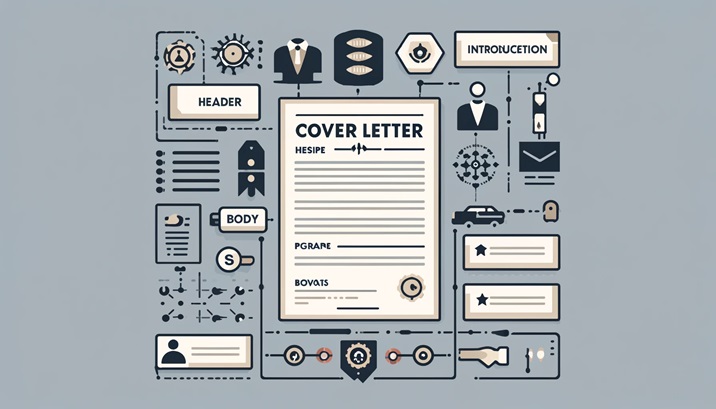
A cover letter is not a creative writing exercise. It is a four-paragraph structure that hiring managers expect, which means they can skim it quickly and still extract everything they need. Deviate only if you have a specific reason.
| Paragraph | Purpose | Target Length |
|---|---|---|
| 1. Opening hook | Name the role, name the company, and state the single strongest reason you are a fit. Optionally reference a recent company event. | 2 to 3 sentences |
| 2. Proof story | One specific, quantified achievement from your resume that maps to the top job requirement. This is where you earn the interview. | 3 to 5 sentences |
| 3. Fit and value | Connect two or three additional skills to the job description. Reference why you want to work at this specific company. | 3 to 4 sentences |
| 4. Closing and call to action | Thank the reader, restate interest, and propose next steps. No weak "hope to hear from you" language. | 2 to 3 sentences |
For formatting specifics (fonts, margins, spacing, salutation style), see our companion cover letter format guide. For proven opening lines see the next section. For closing lines, see how to end a cover letter.
Opening Lines That Get Read: 5 Patterns With Examples
Hiring managers we have interviewed consistently name the opening as the single factor that decides whether the letter gets a full read or a 10-second skim. Avoid every version of "I am writing to express my interest in..." The patterns below are the ones that consistently earn the 47 seconds.
Pattern 1: Quantified achievement hook
"Last quarter I closed $2.3M in net-new ARR at a Series B SaaS company, 140% of my quota. When I saw the Enterprise AE role on the Acme careers page, I realized I could do the same thing for your team, against a larger deal band and a better product."
Why it works: leads with a specific number, implies fit, and names the company in the first two sentences.
Pattern 2: Company-specific hook
"Your January 2026 launch of the Workday integration for smaller HR teams is exactly the problem I spent the last three years solving at Zenefits. I am writing to apply for the Senior Product Marketing Manager role."
Why it works: proves research, signals domain fit, and gets to the point in two sentences.
Pattern 3: Direct mission alignment
"I chose nursing because I wanted to close the care gap for patients who had fallen through cracks in the system. MedStar's community health initiative is the most rigorous version of that work I have seen in the DC market, which is why I am applying for the RN Community Care position."
Why it works: fits mission-driven orgs, healthcare, non-profits, education.
Pattern 4: Referral name-drop
"Maria Chen on your platform team recommended I apply for the Staff Engineer role. I led the Kubernetes migration Maria mentioned to you at Stripe, cutting deployment time from 40 minutes to 90 seconds."
Why it works: referrals account for 30 to 50% of hires (SHRM 2024); lead with the name immediately.
Pattern 5: Problem and solution
"Most enterprise sales teams miss quota because their SDRs cannot get past the inbox. I designed a cold email system at Outreach that got a 27% reply rate. I am applying for the Sales Development Manager role to bring the same playbook to Gong."
Why it works: frames you as a solution, not a job seeker.
For 20 more opening lines across industries and experience levels, see our cover letter examples library.
The Proof Paragraph: How to Turn One Bullet Into a Mini Case Study
This is the paragraph that separates cover letters that earn interviews from cover letters that get filed. Pick the single strongest bullet from your resume that maps to the top job requirement. Then turn it into a 4-sentence mini case study using the SCAR framework: Situation, Challenge, Action, Result.
Example: turning a bullet into a SCAR proof paragraph
Resume bullet: "Reduced customer churn by 34% through a new onboarding program."
Rewritten as proof paragraph:
"In my second month at Paddle I inherited a 22% quarterly churn rate that was driving our CEO's exit from the enterprise market. I redesigned the onboarding flow from a one-off sales handoff into a 30-60-90 day program with scheduled check-ins, a success metric for the customer, and an internal escalation channel. By quarter three, churn dropped to 14.5%, a 34% reduction, and we saved $4.1M in ARR. That is the type of program I want to build for your Customer Success team as you scale past your Series C."
Notice how the rewritten version earns the same 47 seconds more efficiently than five short bullets would. One concrete story beats five abstract claims every time.
ATS Rules: How to Make Sure Your Cover Letter Gets Parsed
Jobscan's 2024 analysis found that approximately 70% of ATS platforms index cover letter text for keyword matching, just like the resume. That means a cover letter with zero keywords from the job description can actually hurt your application score on platforms like Workday and Taleo. Follow these rules to stay safe.
| Do | Avoid |
|---|---|
| Save as .docx or .pdf (match the job posting's instruction) | .pages, .txt, .rtf, Google Docs links |
| Standard fonts: Calibri, Arial, Georgia, Helvetica 11 to 12pt | Script fonts, custom fonts, font sizes under 10pt |
| Plain text, single column | Text boxes, tables, columns, headers, footers |
| Include 5 to 8 exact keywords from the job description | Keyword stuffing or repetition that reads unnaturally |
| One page, 300 to 400 words | Two pages, 500+ words, or one short paragraph |
| File name: FirstName-LastName-CoverLetter.docx | cover-letter-final-v3.docx, Untitled.docx |
Complete Example: Cover Letter for a Senior Marketing Manager Role
Maya Rodriguez
maya.rodriguez@email.com | (555) 234-9812
linkedin.com/in/mayarodriguez
April 9, 2026
Jennifer Park
Director of Marketing
Ascent Analytics
San Francisco, CA
Dear Jennifer,
Your February 2026 launch of the Ascent for Finance vertical is exactly the kind of category expansion I spent the last three years leading at Ramp. I am applying for the Senior Marketing Manager, Vertical Growth role because I can shorten your time to category leadership by at least two quarters.
At Ramp, I owned the launch of Ramp for Healthcare, a new vertical that needed to win a crowded category against Bill.com and Mercury. I built a 90-day go-to-market plan that combined a vertical-specific pricing page, six co-marketed webinars with industry associations, and a paid search strategy targeting 47 healthcare-specific keywords. The result was 1,284 qualified leads in the first quarter, a 38% close rate, and $8.2M in new ARR, which beat the original target by 162%. That work was named a top three marketing initiative of the year in Ramp's 2024 annual report.
Beyond vertical launches, I bring deep B2B SaaS content expertise (I built the Ramp Finance blog from 0 to 180K monthly visits), familiarity with the tools in your stack (HubSpot, Mutiny, Clearbit), and a preference for working with small, high-autonomy teams. The Ascent Analytics emphasis on customer-led growth is the environment where I do my best work.
I would welcome the chance to walk you through the Ramp for Healthcare launch playbook in a 30-minute call. I am available any afternoon next week. Thank you for the time.
Sincerely,
Maya Rodriguez
Word count: 312. Read time: approximately 75 seconds. Keyword density: 8 direct matches to a sample job description. This letter would earn its full read.
7 Cover Letter Mistakes That Get You Filed Instantly
1. Restating your resume
Hiring managers already have your resume. The cover letter is your chance to give context, not repeat bullets.
2. Generic "To Whom It May Concern"
Signals zero research. Find a name or use the team or department title ("Dear Marketing Hiring Team").
3. Leading with "I am writing to apply for..."
Weakest opening line in the English language. Lead with a hook, not a transaction.
4. No quantified achievements
Vague claims like "increased sales significantly" get skipped. Numbers are the currency of credibility.
5. Talking about what the job does for you
"This role will give me great growth opportunities" is an employee perspective. Flip it: what you do for them.
6. Over one page
Target 300 to 400 words. Anything longer gets skimmed or skipped, wasting your strongest content.
7. Typos and grammar errors
Robert Half found 76% of hiring managers reject candidates for a single typo in the cover letter. Proof it twice.
Next Steps
Writing a great cover letter is a 90-minute investment per application, not 5 minutes. That is why most candidates skip it, and why the candidates who do it well have a structural advantage. If you want to move faster without losing quality, paste your resume and the job description into our free ATS resume checker to see which keywords the employer wants most. Then use those keywords as the backbone of the proof paragraph above.
For adjacent reading, see our cover letter format guide, cover letter examples library, how to address a cover letter without a name, and how to end a cover letter. If you want AI to handle the first draft, see our comparison of free cover letter generators or try using ChatGPT with targeted prompts.
Optimize your resume for any ATS instantly
Upload your resume for a free ATS-optimized version. Add a job description to also get a match analysis and targeted cover letter. Only your email is required.
Related Articles
Cover Letter Format: The Exact Structure That Gets Read in 2026
The correct cover letter format: 7 elements in order, ATS rules, font and margin specs, industry variations, and a compl...
Read More
Cover Letter Examples for Every Job Type in 2026
Browse real cover letter examples for software engineers, marketing managers, accountants, and more. Each example includ...
Read More
Are Cover Letters Still Necessary in 2026? Data Says...
Are cover letters still necessary in 2026? We analyzed hiring data to settle the debate. See when cover letters matter, ...
Read More